


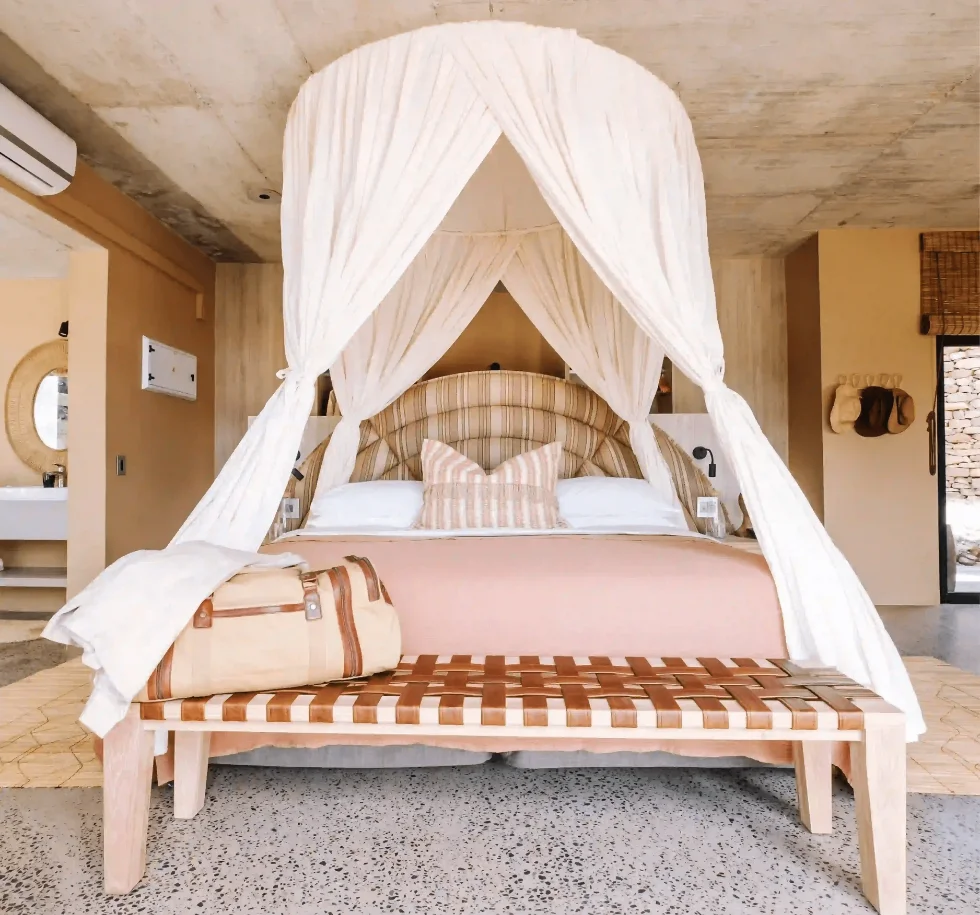
The stone walls of a Mthembu Lodge suite were laid by hand, block by block, by members of the Mthembu clan on land their family has called home for five hundred years. Guests often notice the texture first, uneven in places, still warm from the day’s heat by the time the light turns amber over the White iMfolozi River below.
A hippo grunts somewhere along the far bank. Nobody hurries to look.
That unhurried quality is close to the point. Mthembu Lodge luxury has little to do with polish for its own sake and everything to do with where the lodge sits, who built it and what a stay here continues to support.
Seven one-bedroom suites and two family suites, arranged in a circle that carries specific meaning within Zulu tradition, look out over a river that shaped a conservation recovery few visitors know the full story of until they arrive.
A Circle Five Hundred Years in the Making
The circular layout is not a design flourish. In Zulu tradition, the shape represents wholeness, and the lodge was built to hold that meaning rather than simply reference it.
The land itself came into the reserve in 2010, when iNkosi Mthembu partnered with mFulaWozi’s founders, joining nine other amakosi, all descendants of the Shaka dynasty, who together released 16,000 hectares of tribal bushveld into conservation use.
That decision is why Mthembu Lodge exists where it does, on the embankment of the White iMfolozi River rather than on land cleared for the purpose.
The suites were raised afterwards, by the community whose name the lodge carries, using stonework techniques passed down rather than taught in a course.
Nine Suites, Built Rather Than Furnished
Seven one-bedroom suites and two family suites – the family suites sleeping up to four – make up the lodge’s accommodation.
Every suite has its own private deck, positioned so that wildlife moving down to the river passes in view of the bed rather than somewhere beyond it. A shared swimming pool sits at the heart of the main lodge, alongside a walk-in wine cellar, a gift shop and an outdoor boma used for dining beneath the stars.
Air-conditioned king-size beds, coffee and tea stations and WiFi are standard. Spa treatments and laundry service can be arranged on request.
None of this is presented as a checklist inside the lodge itself, and it reads better that way here too: a private deck is less a feature than a place to watch elephant cross the riverbed at dusk, or simply sit with the sound of the water long after dinner.

Where the River Writes the Day
Two Big Five game drives leave Mthembu Lodge each day, tracking black and white rhino, elephant, Cape buffalo, lion and leopard through terrain shaped by the White iMfolozi River.
African wild dog move through in loose packs, spotted hyena appear at the lodge’s edge without warning, and the reserve’s more than 400 recorded bird species mean the morning rarely passes without a call worth stopping for.
Because Hluhluwe iMfolozi Park remains one of the last fenceless expanses in the region, sightings shift with the season rather than repeating themselves. A guide’s read of fresh spoor along the riverbank often says more about where the day will go than any fixed route could.
Guides Who Grew Up Here
The guides leading these drives grew up in the communities surrounding the reserve, and their knowledge of the land runs deeper than route familiarity.
They are conversant with the history and culture of the Zulu people, able to point out a battlefield site or explain a nearby place name in the same breath as reading animal tracks. That layering, wildlife knowledge alongside cultural history, is part of what separates a drive here from a standard game-viewing circuit.
A Population Once Down to a Hundred
By the late 1800s, fewer than a hundred white rhino remained anywhere on earth. The population that now grazes the plains below Mthembu Lodge is part of the recovery that followed, ranked among the six most important white rhino strongholds by the IUCN African Rhino Specialist Group.
Elephant, absent from this ground for eighty years after historic overhunting, were reintroduced and now number close to 700, their growth managed through contraception to keep the herd in balance with the land.
None of that recovery is separate from the guests who stay here. Revenue from Mthembu Lodge feeds directly into the reserve’s conservation work, from anti-poaching patrols to the training of local field staff who carry the work forward once a stay has ended.
On Foot, Beyond the Suite
For those who want to meet this landscape rather than observe it, Wilderness Walks leave from Mthembu Lodge carrying day packs across 7 to 15 kilometres toward a fly camp with no fixed trail.
Dr Ian Player, reflecting on this same wilderness, wrote: “Wilderness is for me salvation. You are not human if you aren’t changed by the wilderness.” Guests who take that walk tend to return to the lodge’s comfort with a sharper sense of what it means.
A Reserve Built With, Not For
mFulaWozi describes its purpose as more than magnificent game viewing and fine cuisine; it calls itself, in its own words, a journey of purpose.
At Mthembu Lodge, that shows up as tourism revenue tied directly to hospitality and field guiding qualifications for the surrounding community, and a lodge built by, rather than simply named for, the clan whose land it occupies. Guests interested in the wider reserve’s founding partnership can trace how ten Zulu chiefs shaped the reserve that exists today.
Recognised in 2025
mFulaWozi Wilderness, home to Mthembu Lodge, received the 2025 Luxury Lifestyle Award for Best Luxury Safari Lodge in KwaZulu-Natal. It is worth mentioning once, plainly, rather than repeated throughout this article: the recognition reflects a lodge built on partnership and conservation outcomes rather than amenities alone.
Planning a Stay
Seven one-bedroom suites and two family suites make up the lodge, the latter suited to groups of up to four.
Wildlife across the reserve includes the Big Five alongside African wild dog, spotted hyena and the reserve’s considerable bird diversity, with sightings varying by season.
Rates and availability for Mthembu Lodge are listed on the lodge’s own booking page, with current seasonal rates on the reserve’s rates page; those weighing the two lodges against each other may also want to compare Biyela Lodge’s hillside suites before deciding.
An Evening on the Deck
By the time the light drops fully behind the escarpment, the stone that felt warm under a guest’s palm that afternoon has cooled, and the river below carries on regardless of who is watching.
Mthembu Lodge luxury, in the end, is this: a suite built by hand, on land the Mthembu clan chose to return to the wild rather than develop, with nothing between a guest and the sound of the water but a private deck and an unhurried evening.
Discover Mthembu Lodge to plan a stay, or read more about the lodge’s story before you enquire.